Keeping Local Beef Local
By Karl Wiggers
Louisiana Farm Bureau News
On a farm in Rapides Parish, the next generation is already learning the family business.
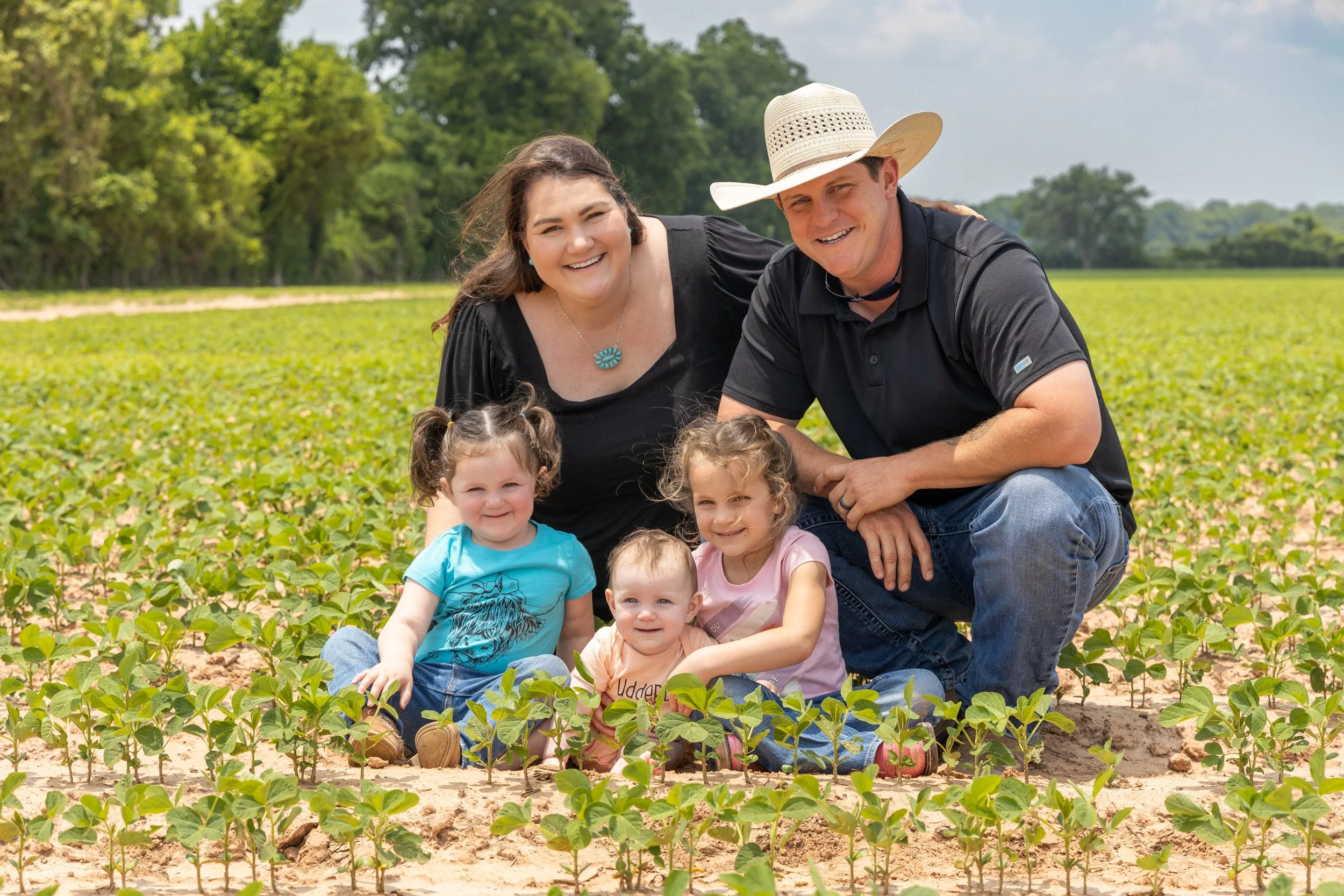
Robert and Rachel Duncan's three young daughters follow their parents through soybean fields, check cattle and find plenty of ways to get their hands dirty.
For Robert, watching them experience farm life brings back memories of his own childhood.
“Oh, it's no other feeling,” he said. “Just because it's the nostalgia of it's the same exact thing I did when I was their age.”
Robert grew up knowing agriculture as a way of life.
“My great-grandfather was a farmer. My grandfather farmed. My dad and my uncles farmed,” he said. “So it's all I've ever done.”
Rachel grew up around horses and agriculture, too, but her experience was different.
“I grew up barrel racing and riding horses and stuff, but it was nothing like how deep in agriculture Robert and his family are,” she said.
Together, they are now raising the fifth generation of their family to experience that life.
But keeping a family farm going isn't always about getting bigger.
In fact, one of the most important decisions the Duncans have made was to get smaller.
Over the last decade, circumstances forced the family to reduce the operation from about 3,200 acres to fewer than 500 acres of row crops and pasture.
“Nobody wants to get smaller,” Robert said. “I guess everybody's idea is to get bigger and get bigger. But we took the opportunity of getting smaller to get better.”
Getting better meant finding new ways to make the farm work.
Today, the Duncans grow soybeans, make their own hay and maintain a herd of roughly 200 mama cows. And in recent years, they have found another opportunity in an increasingly personal part of the beef business: selling their cattle's beef directly to people in their own community.
They began selling beef directly to consumers in 2017, retaining ownership of cattle and finding a way to capture more value from animals that otherwise would have gone through traditional livestock markets.
“You know, that's why we started it originally in 2018, was being able to take those cows and make a little more money with them than we were just sending them, whether it be the sale or through Superior Livestock,” Robert said.
But the business became about more than improving the farm's bottom line.
It became about feeding the people who live around them.
“We really enjoy the aspect of being able to sell to the neighbors and keeping local meat in local people,” Robert said.
Rachel handles much of the marketing and sales, using social media to connect with customers. People sometimes stop by the farm looking for something specific for dinner.
“I market on social media for it, I even do the selling,” she said. “People come to the house all the time, ‘Hey, I need some meat. I need some ribeyes, or I need five pounds of ground meat.’”
For those customers, the relationship is different from buying beef at a grocery store.
They know the people who raised the cattle. And if they want to know more, the Duncans are happy to show them.
“Being able to buy it local, you know, from your neighbor, say this is how it was raised, and they can show you,” Robert said. “If somebody wants to come out here and look, we'll be glad to show them how it's raised and what we do to raise them and get them to that point.”
The demand has grown.
The first year they sold beef, the Duncans supplied three customers. The next year, that number grew to 13.
“There’s a demand,” Robert said. “People want it. You know, if we can give it to them, we'll be glad to.”
That direct connection between the farm and the dinner table is something the Duncans take pride in.
It is also a reminder that farming doesn't always follow a straight line.
When wet weather prevents them from planting soybeans, the cattle become even more important. When market conditions change, they look for another opportunity. And when traditional farming methods don't provide enough room to grow, they find a different way to make the farm work.
That same willingness to diversify led Rachel to start another small farming venture: Bayou Petals Flower Farm.
She began in 2019 with $500 and just a sixteenth of an acre, encouraged by friends she met through Louisiana Farm Bureau's Young Farmers and Ranchers program.
“I started with a 16th of an acre, like something super, super small,” Rachel said. “And from there it has just grown and grown.”
The flower farm now occupies a quarter of an acre—a small footprint compared with the Duncans' cattle and row-crop operation, but one that has provided another source of income and another connection with the local community.
After the first year, Rachel and Robert realized just how productive a small piece of land could be.
“Robert was absolutely amazed after the first year,” Rachel said. “We kind of crunched some numbers and did like rough figuring in my little 16th of an acre made more money than three acres of soybeans.”
For a farm family with young children, diversification isn't just about economics. It can also be about creating a life that works.
The Duncans' days don't always fit neatly into business hours.
Rachel handles paperwork and farm responsibilities while Robert is working in the field or with cattle. Robert returns the favor when Rachel needs help with spraying or other jobs on the flower farm.
“You're not getting stuff done during regular business hours,” Robert said. “So, you know, without her things down here, around here would stop.”
Rachel knows the same is true in the other direction.
“Any kind of pesticide application or any kind of spraying that I need—if we have something that's really serious going on, he takes care of that for me,” she said.
And when the stresses of farming begin to pile up, they lean on each other.
“So any way him and I can lean on each other, we do,” Rachel said. “We talk about it. We try not to leave anything bottled up. We help each other as much as we can and we just take one day at a time.”
Because on a farm, the work doesn't end when the tractor is parked.
“You don't get to stop at the door and take your boots off and leave it outside,” Robert said. “You go home and you eat supper and you're thinking about it, you're talking, putting your kids in the bathtub and in the barn you're thinking about it and you're going to bed thinking about it. You wake up thinking about it.”
There are always more decisions to make.
A wet spring can change the planting plan. A changing cattle market can change the way animals are sold. A smaller farm has to make every acre count.
But those challenges have also taught the Duncans how to adapt.
“Somebody's gotta do it,” Robert said. “And we, you know, we love it and that's why we keep doing it.”
Sometimes, that means accepting that the original plan won't work.
“We may not get to plant every acre this year,” he said. “We might have to change up, change our original plan and do something different. You just take what you have and go with it.”
That philosophy extends beyond the crops and cattle.
The Duncans see themselves as caretakers of land that existed before them and, they hope, will remain long after them.
“When you think of sustainability, you should be able to think about doing this again next year and the next year and the next year,” Robert said. “Everybody wants to think that farmers are, you know, tearing stuff up or just destroying the country or the planet, when all reality, we're probably taking better care of it than most because we've got to have this land forever.”
Rachel sees that responsibility in generational terms.
“We are stewards of the land,” she said. “We are taking care of this land for our next generation. It's a very prideful thing. The generation before us kept it intact, so we're trying to keep it intact for those to come.”
For the Duncans, that next generation is already walking the farm.
Their daughters are learning where food comes from by standing beside the people who produce it.
“To instill that importance into our children and have them there one on one with us, so that when they start school, they can tell their friends, ‘We grow stuff like that. We produce food that we eat,’” Rachel said.
That may be the most important crop the Duncans are growing.
The soybeans will be harvested. The hay will be baled. The cattle will eventually become beef for families around them. Flowers will bloom and be sold to people looking for something to brighten their day.
But alongside all of that, Robert and Rachel are cultivating something that can't be measured in acres.
A connection to the land.
A willingness to adapt.
And, if they're fortunate, another generation that will look at the farm and decide there is nowhere else they'd rather be.