Congressman Troy Carter joins the show for DC Current to share his thoughts on peaceful protests on college campuses, emergency assistance to Louisiana’s Crawfish Aquaculture Industry, along with the misuse and abuse of AI.
Read More
Congressman Troy Carter joins the show for DC Current to share his thoughts on peaceful protests on college campuses, emergency assistance to Louisiana’s Crawfish Aquaculture Industry, along with the misuse and abuse of AI.
Read MoreIn a second round of Big Idea seed grants, the largest internal funding program in LSU history, the Provost’s Fund for Innovation in Research is investing $1.2 million in 15 interdisciplinary research teams. Aligned with LSU’s Scholarship First Agenda, the teams and their projects aim to solve pressing problems in Louisiana and everywhere.
In total, the funded projects will engage 65 faculty across nine colleges and schools on LSU’s flagship campus in Baton Rouge, extending collaboration to LSU Athletics, LSU AgCenter, Pennington Biomedical Research Center and LSU Health New Orleans. Two projects support advances in agriculture; seven projects drive discovery in biomedicine; six projects elevate the coast and environment; six projects protect the state and nation through stronger defense and cybersecurity; and six projects help secure the future of energy.
Read MoreU.S. Department of Agriculture (USDA) Farm Service Agency (FSA) today announced that all 64 Louisiana parishes have been approved for the Emergency Forest Restoration Program (EFRP) to restore and rehabilitate private forest lands impacted by severe drought and related insect infestation damage. The EFRP signup period runs from May 13, 2024, to July 12, 2024.
EFRP is a cost-share program that provides financial and technical assistance to owners of nonindustrial private forestland (NIPF) to restore NIPF damaged by a qualifying natural disaster event.
Read MoreLast year was one for the ages across Louisiana, and NOT in a good way. I did a brief dive into a comparison of the numbers from this year and last year, since May 15th 2023 was the point where we went from a pretty normal year, to one of the most incredible droughts and heat waves in recent history. I used Alexandria for this exercise since it is right in the middle of the state, and I had already used it for my local update.
Read MoreLouisiana's soybean planting progressed well in mid-April, exceeding the five-year average. However, heavy rains in mid-May slowed progress, with only 69% planted by May 12th, 2024. This lags behind last year's 76% at the same point. An article, “The Farmer's Forecast: More Soybean Planting Delays” indicates continued rain and potential wind/hail threats.
Read MoreClick below for the market report from the latest Kinder Livestock Auction.
Read MoreThanks to Buck Leonards and the staff at Louisiana Farm & Ranch for providing the digital edition of the May 2024 issue.
Read MoreMinding the Forest drops a new episode May 15 featuring Dr. Laura Sims, assistant professor at Louisiana Tech University, who is studying Brown Spot Needle Blight.
The podcast can be found on the Louisiana Forestry Association website, https://www.laforestry.com/podcast
Read MoreThe cicadas are coming. Are your trees and shrubs ready for the invasion?
The emerging Brood XII and Brood XIX cicadas love to target deciduous trees, or those that with leaves that change colors and drop in the fall. No need to worry about those evergreen trees, known as coniferous trees, which can maintain their leaves throughout the year. Cicadas don't like them.
Read MoreWith summer comes outdoor activities and the possibility of encountering ticks and the diseases they carry. To determine which species may be common to a particular location in Louisiana, an LSU AgCenter researcher and her team have developed an online tool to assist in locating the bloodsuckers.
AgCenter entomologist Kristen Healy has been working with the Louisiana Department of Health and Tulane University to better understand the risk for tickborne diseases in Louisiana. According to Healy, the state hasn't had a survey of ticks in decades, and much of the current knowledge predates that of the introduction of imported fire ants.
Read More“Crawfish aren’t just essential to my restaurant, they’re central to our culture here in south Louisiana,” explained Jason Seither, owner of Seither’s Seafood in Harahan, Louisiana, just outside of New Orleans. “And when crawfish prices get as high as they got this season, it threatens an entire way of life.”
On any given year, these two-clawed, ten-legged red crustaceans — reminiscent of a lobster but much smaller at only three to six inches long — dominate springtime social gatherings and the menus of casual restaurants across Louisiana and beyond.
Read MoreOn a breezy sunny evening in May, before the heat of summer settles in, a dozen or so people gathered in what was once a vacant lot in Baton Rouge’s Zion City but is now a growing community garden.
Only minor work was being done in the garden that day — a little pruning, a couple of plantings. Mostly, the group sat in lawn chairs, while Clifford Payne tended hamburgers on a grill. This lot, which was filled with waist-high weeds just a few months earlier, has become a meeting spot for the community.
Read MoreThe 2024/25 U.S. corn outlook is for larger supplies, greater domestic use and exports, and higher ending stocks. The corn crop is projected at 14.9 billion bushels, 3 percent down from last year’s record as increases in yield helped partially offset decreased area. The yield projection of 181.0 bushels per acre is based on a weather-adjusted trend assuming normal planting progress and summer growing season weather, estimated using the 1988-2023 period.
Read More
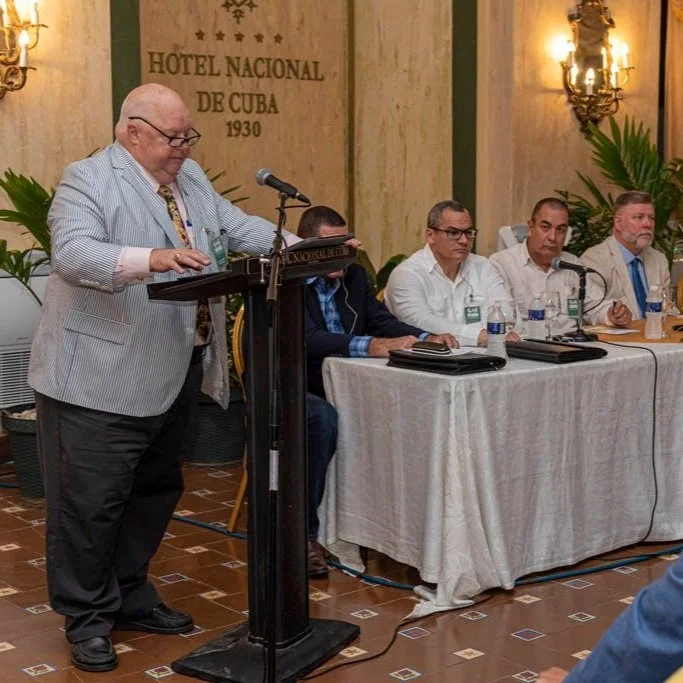
In the opinion of U.S. Congressman Rick Crawford, holding this type of meetings on a regular basis constitutes progress, although “we are still not where we would like to be”.
For any country in the world, food security is an essential component of national security, the legislator, who appreciated the growing support within the United States for agricultural initiatives in favor of regularizing economic and trade relations with the island, said.
Read MorePublic and private cost-share programs give farmers the option to test new technology and conservation practices with lower financial risk before footing the bill of whole-scale implementation.
For the Wiggers Farm Partnership in Winnsboro, La., utilizing cost-share programs available through NRCS, especially the Conservation Stewardship Program, has enabled them to make compounding changes to irrigation equipment, soil improvements and more.
Read More