Soybeans Bringing Record Prices & Historical Exports In Brazil
Soybeans prices are selling at highs in Brazil because of strong internal and external demand, rising prices on the Chicago Mercantile Exchange, and a weak Brazilian real couple with a strengthening U.S. dollar. Prices have risen at the same time that Brazil, the world’s largest soybean producer, has achieved a new record harvest. The 2020/2021 forecast indicates Brazil will harvest 4.97 billion bushels, 8.5% more soybeans than last season. In addition, Brazil´s soybean exports increased dramatically in the last months, reaching historic highs, including unusual sales to the United States.
Read More
Heavy Flooding Impacts Local Crops
Southwest Louisiana crops have been impacted by the recreant heavy rainfall and flooding.
Many crop fields in Calcasieu were submerged in the flood. Though all plants need water to grow, experts said crops in this region do better when it’s hot and dry.
Read More
Dicamba Settlement Deadline: May 28
May 28 is the last day to file a claim in the dicamba soybean settlement. Producers with evidence of dicamba damage in soybeans occurring from 2015 through 2020 are eligible to file a claim. The courts have set aside $300 million for soybean producers who experienced damage and $100 million for administrative costs.
Read More
Organic Soybean Meal Imports From India Under Scrutiny
Over the past several years, Indian organic meal has flooded the U.S. market, jumping from just 2% before the surge to now owning nearly 70% of the U.S. organic meal market. U.S.-produced organic soybean meal meanwhile has plummeted from 80% of the market to just over 30%.
The United States International Trade Commission (USITC) determined that there is a reasonable indication that a U.S. industry is materially injured by reason of imports of organic soybean meal from India that are allegedly subsidized and sold in the United States at less than fair value.
Read More
First Look at 2021/22 Marketing Year Following Sky-Rocketing 2020/21 Export Demand
The May World Agricultural Supply and Demand Estimates gives the first look at the newest marketing year demand expectations since the USDA Agricultural Outlook Forum in February. This is the highlight of spring USDA reports as it incorporates farmer planting decisions from the March Prospective Planting report and adapts supply estimates to reflect weekly planting progress reports. The big story leading up to this report is rising prices due to the increased global demand for U.S. commodities. This Market Intel dives into the May WASDE for updated estimates of the current 2020/21 marketing year crop and assesses what could be in store for the newest 2021/22 marketing year, which starts in September.
Read More
Bad Weather put Soybean Planting Behind in Louisiana
Bad weather has put Louisiana soybean farmers behind schedule, but rising prices are likely to increase acreage from last year, a Louisiana State University soybean specialist says.
Louisiana farmers have planted about 24% of the acres they plan for soybeans, compared to a 5-year average of 47% by this time, the U.S. Department of Agriculture’s National Agricultural Statistics Service reported Monday.
Read More
Soybean Planting Going Slow For Louisiana Growers
Wet weather and cooler temperatures have put Louisiana soybean planting behind schedule. The optimum planting date for soybeans in the state is mid-May, and growers will be hard pressed to meet this deadline. LSU AgCenter reporter Craig Gautreaux has the story.
Read More
Soybean Planting Well Behind Schedule
When they can, Louisiana soybean farmers have been busy planting as many acres as the weather allows. Unfortunately, many producers have not been able to get in their fields as often as they would like.
According to a May 3 report from the U.S. Department of Agriculture National Agricultural Statistics Service, approximately 24% of the state’s intended soybean acres had been planted. The five-year average for this date is 47%.
Read More
Planting Season Hampered by Rain
Planting season for area crops has been “hit and miss” due to uncooperative weather, said Carol Pinnell-Alison, LSU County Extension agent.
With corn planting season complete, farmers are busy fertilizing and performing weed control between rain showers on the crop.
Area farmers planted some 98,000 acres of corn last season, up from the previous year’s total of 72,000, according to Farm Service Agency (FSA) certified acreage numbers.
Read More
Fundamentals Show That the Soybean Market Is Overbought, Analyst Says
When considering the near-term fundamentals, the soybean market remains overbought, and a turn down in vegetable oil prices might spark a significant correction.
July soybeans have consolidated below the April 27 contract high and key reversal day.
The rally in the grain and soy markets has been led by continued dryness for the second corn crop in Brazil, which is causing significant stress. A lot of key growing areas do not have rain in the 7-day forecast, and this continues to drive the corn market higher.
Read More
To Replant or Not to Replant? Consider the Economics
The economic impact on direct farm-level production costs from replanting soybeans can result in an increase in the number of bushels that will be required to offset the incurred production expenses associated with replanting field operations.
The severity of this will depend on the type of soybean technology employed, as differences in the prices for seed, seed treatments and seeding rate can influence the replanting costs and, hence, the number of additional bushels required at harvest to offset those costs.
Read More
Mysterious Soybean Fungus Identified By LSU Student
LSU AgCenter Plant Pathologist Dr. Vinson Doyle says a fungus that has been devastating to soybeans has been identified and named by one of his grad students, Teddy Garcia Aroca. Doyle says they discovered the pathogen was probably mis-identified a long time ago.
Read More
3 Reasons Corn Prices Shot Past $7
Up. Up. Up. May 2021 corn futures topped $7 per bushel on April 27. A look at the corn price chart shows a dramatic and consistent climb higher. You can find multi-year highs in many ag commodities.
“These are one of those times that come along generally once every 30 years or so when the markets just really take off,” says Arlan Suderman, StoneX chief commodities economist. “And we just went through this about 12 years ago or so.”
Read More
Rice Market: Corn, Soy Strength Provide Spillover Support
September rice futures continued higher this week along with the rest of the CBOT grains. The graphs below illustrate the price trends for the major grains since March 30, 2021. New crop corn, wheat, and soybeans have all added over $1/bu following the NASS Prospective Plantings report released on March 31.
Recall the findings from the survey resulted in limit moves higher in corn and soybeans. Corn futures have caught fire this month as estimates of Brazil’s production continue to fall. From a relative price standpoint, soybeans are losing the acreage battle to corn.
Read More
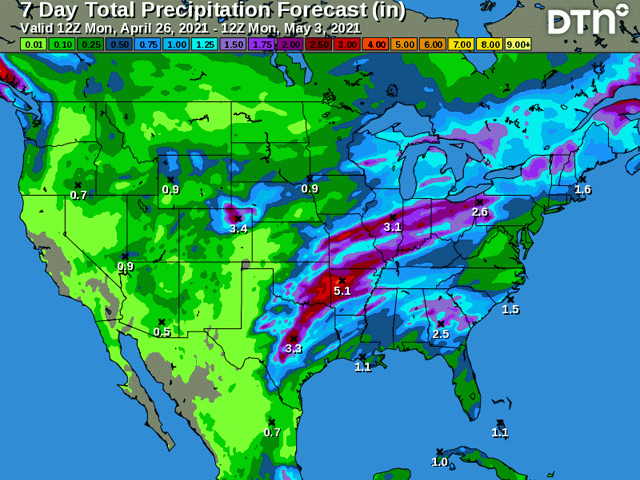
Wet Week Ahead
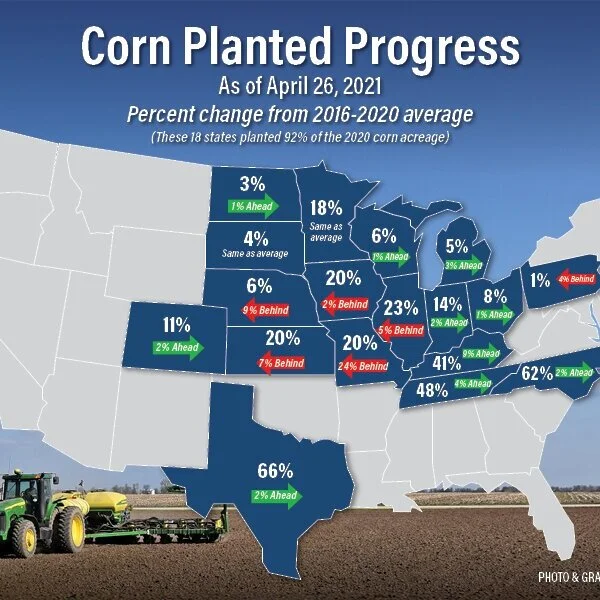
A review and forecast of the U.S. crop weather scene begins with the impact of the cold snap during the April 21-27 week. That cold event certainly left its mark. Winter wheat in either good or excellent condition declined by four percentage points overall from the previous week to 49% rated good to excellent compared with 53% the previous week. Oklahoma and Texas showed declines in the good-to-excellent totals of 9 percentage points in Oklahoma (70% to 61%) and 10 points in Texas (28% to 18%). In addition, corn planting was slowed by the cold outbreak. Planting did advance 9 percentage points to 17% complete, but fell behind the average pace of 20%.
Read More