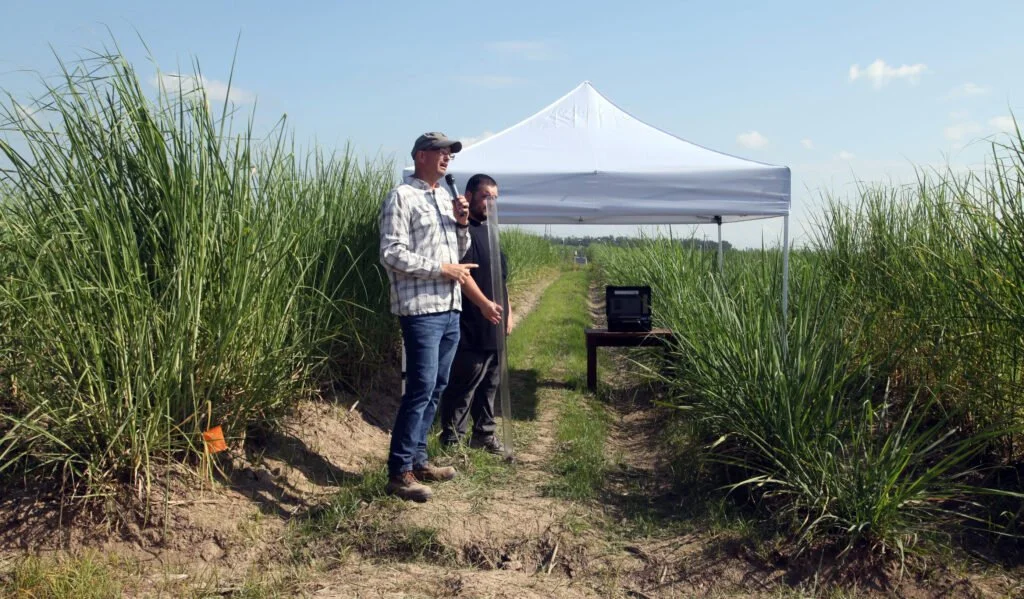
One may think that a lack of new varieties being announced at the annual LSU AgCenter sugarcane field day would mean that research efforts have slowed down, but the opposite is true. It means the science is working.
Read More
One may think that a lack of new varieties being announced at the annual LSU AgCenter sugarcane field day would mean that research efforts have slowed down, but the opposite is true. It means the science is working.
Read MoreVolume 13, Issue 5—July, 2023
Read MoreWith his one-year anniversary of serving as LSU vice president for agriculture and dean of the College of Agriculture approaching, Matt Lee said agricultural research and education is entering a new era in Louisiana — one he hopes will be marked by unprecedented scientific innovation and a recommitment to helping the people of the state live better lives.
Read MoreThe Scott Research, Extension & Education Center in Winnsboro will host a soil fertility and nutrient management field day Thusday, July 27, from 8 AM until 1 PM.
Read MoreThis policy newsletter provides a summary of the recent ag-policy related developments from the previous quarter.
Read MoreA field tour to display research being carried out at the LSU AgCenter’s St. Jo location is set for Tuesday, July 25, starting at five o’clock.
It will feature talks on row spacing, fertility, weed control, disease and insect control. There will also be one stop showing the difference between planting cotton into two different cover crops.
Read MoreThe United States Department of Agriculture’s Sugarcane Research Unit in Houma hosted a June 1, 2023 sugarcane field day at its Schriever farm to highlight its centennial of cane research activities in Louisiana.
Read MoreIt is important to follow the label when applying any pesticide, including those labeled for harvest aid in soybean. Some restrictions found on harvest herbicide labels include soybean growth habit (indeterminate versus determinate), growth stage, percent mature pods and percent leaf drop. It is important to follow restrictions on spray volumes and preharvest intervals. Table 1 list herbicides that are labeled for preharvest application in soybean.
Read MoreRecently, there have been increased reports of corn earworms infesting soybean fields across the state. Corn earworm (aka bollworm or soybean podworm) can cause occasional but severe damage to soybean. The primary damage caused by corn earworm occurs during the larval stages when the insect feeds on the soybean flowers and pods. This feeding activity leads to direct yield losses as pods abort, or the larvae consume or injure developing seeds.
Read MoreThe reniform and Southern root-knot nematodes are the two most common nematodes found in Louisiana agricultural fields. These microscopic animals can cause big yield losses, and one scientist with the LSU AgCenter is working on solutions to this problem. AgCenter reporter Craig Gautreaux has the story.
Read MoreHot, sunny weather has quickly matured rice crops across Louisiana, and combines will soon begin harvesting what is expected to be a good crop for growers. LSU AgCenter reporter Craig Gautreaux has the story from southwest Louisiana.
Read MoreThe LSU AgCenter hosted the 53rd annual Louisiana 4-H and FFA State Horseshow from July 10 to 14, at the Lamar-Dixon Expo Center in Gonzales, celebrating the project achievements of youth in the Louisiana 4-H and FFA projects during the past two years.
Hilton Waits, State Horse Show superintendent, reports this year 170 exhibitors participated with 240 horses.
Read MoreThis month’s 2023/24 U.S. corn outlook calls for fractionally higher supplies and ending stocks. Corn beginning stocks were lowered by 50 million bushels, as greater feed and residual use for 2022/23 more than offsets reductions in corn used for ethanol and exports. Corn production for 2023/24 is forecast up 55 million bushels as greater planted and harvested area from the June 30th Acreage report is partially offset by a 4.0-bushel reduction in yield to 177.5 bushels per acre.
Read MoreRivers are Life is proud to announce Louisiana State University has joined the initiative as a contributing academic expert. LSU will bring its deep experience in river conservation and environmental education to Rivers are Life, consulting with River Heroes to further their work to protect river ecosystems worldwide.
Read MoreA major goal of the Louisiana Farm to School Act is to promote the use of locally grown and raised foods in school nutrition programs. One avenue to achieve this is for school food service personnel to source ingredients for school cafeteria meals within the state. In doing this, school districts directly support their local economies and community members who grow these products.
Read More