First Look at 2021/22 Marketing Year Following Sky-Rocketing 2020/21 Export Demand
The May World Agricultural Supply and Demand Estimates gives the first look at the newest marketing year demand expectations since the USDA Agricultural Outlook Forum in February. This is the highlight of spring USDA reports as it incorporates farmer planting decisions from the March Prospective Planting report and adapts supply estimates to reflect weekly planting progress reports. The big story leading up to this report is rising prices due to the increased global demand for U.S. commodities. This Market Intel dives into the May WASDE for updated estimates of the current 2020/21 marketing year crop and assesses what could be in store for the newest 2021/22 marketing year, which starts in September.
Read More
Planting Season Hampered by Rain
Planting season for area crops has been “hit and miss” due to uncooperative weather, said Carol Pinnell-Alison, LSU County Extension agent.
With corn planting season complete, farmers are busy fertilizing and performing weed control between rain showers on the crop.
Area farmers planted some 98,000 acres of corn last season, up from the previous year’s total of 72,000, according to Farm Service Agency (FSA) certified acreage numbers.
Read More
Grain Market Rally: Is It History In The Making?
With recent rallies in May 2021 futures, the price for a nearby corn contract soared to the highest level since June 2013. A combination of fundamental factors has fueled the recent surge including strong ethanol margins, record U.S. corn exports and ongoing dry weather in key corn growing areas of Brazil.
Read More
3 Reasons Corn Prices Shot Past $7
Up. Up. Up. May 2021 corn futures topped $7 per bushel on April 27. A look at the corn price chart shows a dramatic and consistent climb higher. You can find multi-year highs in many ag commodities.
“These are one of those times that come along generally once every 30 years or so when the markets just really take off,” says Arlan Suderman, StoneX chief commodities economist. “And we just went through this about 12 years ago or so.”
Read More
Rice Market: Corn, Soy Strength Provide Spillover Support
September rice futures continued higher this week along with the rest of the CBOT grains. The graphs below illustrate the price trends for the major grains since March 30, 2021. New crop corn, wheat, and soybeans have all added over $1/bu following the NASS Prospective Plantings report released on March 31.
Recall the findings from the survey resulted in limit moves higher in corn and soybeans. Corn futures have caught fire this month as estimates of Brazil’s production continue to fall. From a relative price standpoint, soybeans are losing the acreage battle to corn.
Read More
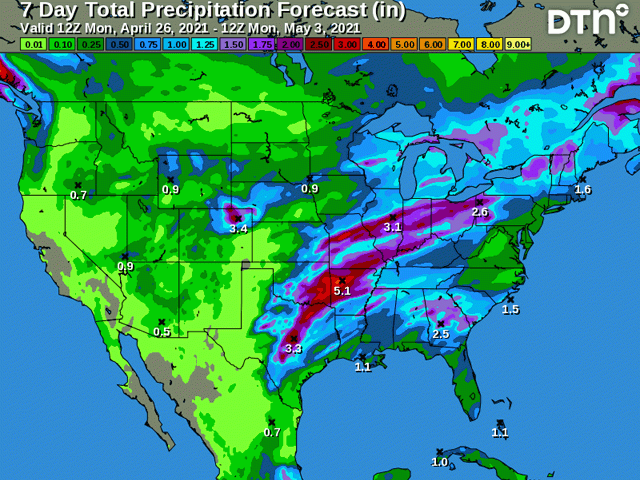
Wet Week Ahead
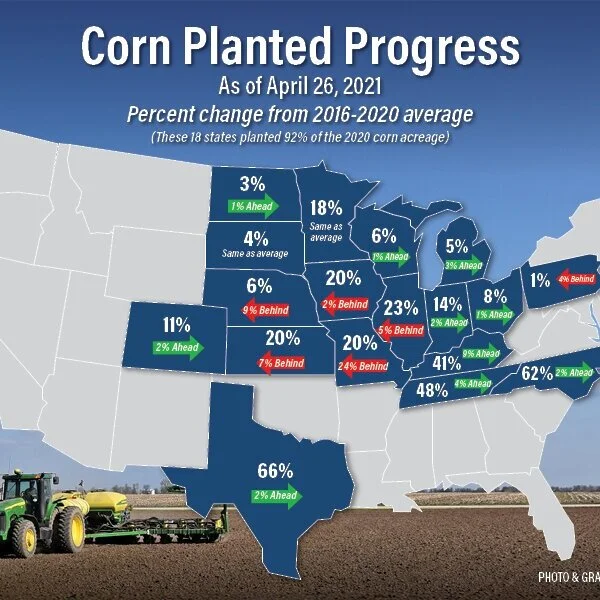
A review and forecast of the U.S. crop weather scene begins with the impact of the cold snap during the April 21-27 week. That cold event certainly left its mark. Winter wheat in either good or excellent condition declined by four percentage points overall from the previous week to 49% rated good to excellent compared with 53% the previous week. Oklahoma and Texas showed declines in the good-to-excellent totals of 9 percentage points in Oklahoma (70% to 61%) and 10 points in Texas (28% to 18%). In addition, corn planting was slowed by the cold outbreak. Planting did advance 9 percentage points to 17% complete, but fell behind the average pace of 20%.
Read More
Planting Progress: Soybeans Ahead of Five-Year Average While Corn Lags Behind
While corn and soybean prices continue to march higher, farmers are making progress getting the 2021 crop in the ground. The latest estimates from USDA show soybean planting progress jumped from 3% to 8% in the past week, which is trending 3% ahead of the five-year average. Around 3% of the soybean crop has emerged, which is 1% ahead of last week. Louisiana trails in planting progress, but the other key soybean production states are tracking with the five-year average or even a bit ahead.
Read More
Corn, Soybean Prices Climb, Record Chinese Corn Imports Expected
Bloomberg writers Kim Chipman and Michael Hirtzer reported on Wednesday that, “Corn prices climbed above $6 a bushel to the loftiest level in almost eight years after the U.S. said it expects China to buy an all-time high amount of the grain off global markets.
Read More
Burndown Options For Corn
Weed management is a year-round job, but producers take special care to make sound management decisions prior to planting—including cover crop burndown.
David Russell, an Alabama Extension weed scientist, offers suggestions for planting into a weed-free field and maintaining a clean corn crop throughout the growing season. Russell’s areas of specialization include corn, soybeans, small grains, forages and non-crops.
Read More
The Mississippi River is Running Lower in Baton Rouge Than Past Years, But Will it Last?
A drier-than-usual year up north has Baton Rouge-area farmers and communities along the Mississippi River breathing a sigh of relief as the threat of flooding due to high water levels may not be a significant headache this year.
The river in Baton Rouge appears to have crested last week at about 38 feet, just over what’s considered a moderate flood stage. The National Weather Service projects waters will gradually continue to fall and could even reach minor flood stages by early next week, even with this week's rains.
Read More
Corn May Be King, But Soybeans Rule US Exports
By a wide margin, soybeans are the most valuable U.S. farm export, accounting for 18¢ of every $1 in sales during calendar 2020, said the USDA’s Foreign Agricultural Service on Wednesday. Corn, the country’s most widely grown crop, was second in export value to soybeans, which were worth a record $25.7 billion compared with $9.2 billion for corn.
Read More
WASDE Report Bullish For Corn, Wheat, Bearish For Soybeans
USDA on Friday lowered corn ending stocks for the 2020-21 by 150 million bushels (mb) to 1.352 billion bushels (bb) but held pat with soybean ending stocks at 120 mb.
USDA raised corn use for feed, seed and industrial use, as well as exports to drop the ending stocks for the crop.
Read More
Stepping on Stepped-up Basis Has Big Consequences
Any change in capital gains tax policy that eliminates or scales back stepped-up basis could result in a massive tax burden on the agricultural sector according to new analysis by the American Soybean Association and the American Farm Bureau Federation.
To minimize the impact of burdensome capital gains taxes, farmers and ranchers use stepped-up basis, which provides a reset for the asset value basis during intergenerational transfers. The magnitude of the tax burden that would be felt if basis is taken away or reduced would likely significantly exceed the annual income generated by the assets, something that has soy and other American farmers concerned.
Read More
Cotton, Rice Down, Corn, Soybeans Up In Latest NASS Report For Louisiana
Louisiana Prospective Plantings Report, March, 2021
Read More
Rebuilding The Grain Bin Destroyed by Hurricane Then Tornado
To understand the weather challenges of growing crops in the Blacklands of North Carolina, the story of both a hurricane and tornado that did in the grain facility of Green Valley Farms near Columbia in Tyrell County fits the bill perfectly.
Read More