
The Long Game: Inside a Family Rice Operation Built on Patience, Research and Getting Involved
The fields looked right. That was the strange part.
Jeffrey Sylvester had watched his rice crop grow into the kind of stand that usually means a good check at the elevator. Then the combine rolled through the field.
"We really don't understand why some of these fields are not yielding like they should," Sylvester said. "They look pretty, but when you get into them, they just — the weight is not there. There’s just blanks going out the back of the combine."
It's the kind of disappointment that never shows up on a grocery store shelf, but it's the reality behind a lot of what does. Sylvester is a partner in the family's rice, crawfish and soybean operation — a farm he and his brothers built into more than 10,000 acres, including over 4,000 in rice.
"It's all right here," he said. "We don't have to hit the highways and go from parish to parish."
It's also, increasingly, a farm run across generations. Sylvester's oldest son now farms his own section — though the two operations still help each other at harvest. Sylvester now has two of his sons farming near him now, and six grandsons are watching all of it.
"I gotta make sure that they have something, if they choose to come back and farm," Sylvester said.
That's not a given. There was a stretch, years ago, when even Sylvester's own future in farming wasn't settled.
"I don't think I'd be farming," he said, "because that was a time my wife was pushing for me to get out of farming and go get a regular job. And I was like, ‘Oh no, this is who I am.’"
What he loves about the work isn't complicated to him. It's the being out in the field— the restlessness of having ground to cover and something on it that always needs doing.
"I'm that guy that drives around after there's nothing to do — drive around miles all over the farm and say, ‘Oh, I wanted to do that,’ and I'll go back and go do that," he said. "You may want to go to the house and sit down on a sofa, that's not me."
But Sylvester is just as animated talking about something most consumers never think about at all: the research and promotion dollars that Louisiana rice farmers pay into with every barrel they sell — money that funds LSU AgCenter variety development, pest and disease research, and the marketing push that puts Louisiana rice in front of buyers.
He traces his own operation's growth directly to it. When LSU came out with the Cypress rice variety in the early 1990s, he said, it changed what a farmer his age could expect from an acre — yields jumping into the 40-plus barrel range, with mill quality that earned a premium. New varieties followed, along with the chemical and fertilizer research that keeps farmers from wasting money on inputs, and the disease research that helps them fight disease before it costs them a crop.
"I don't think my operation could have grown like it's grown without the promotion and checkoff dollars," Sylvester said. "It's kind of like using a highway taxpayers pay for. Somebody paid for it for you to use."
The promotion side, he said, is what turns a good crop into a sold crop — putting Louisiana rice in front of buyers who haven't tasted it yet.
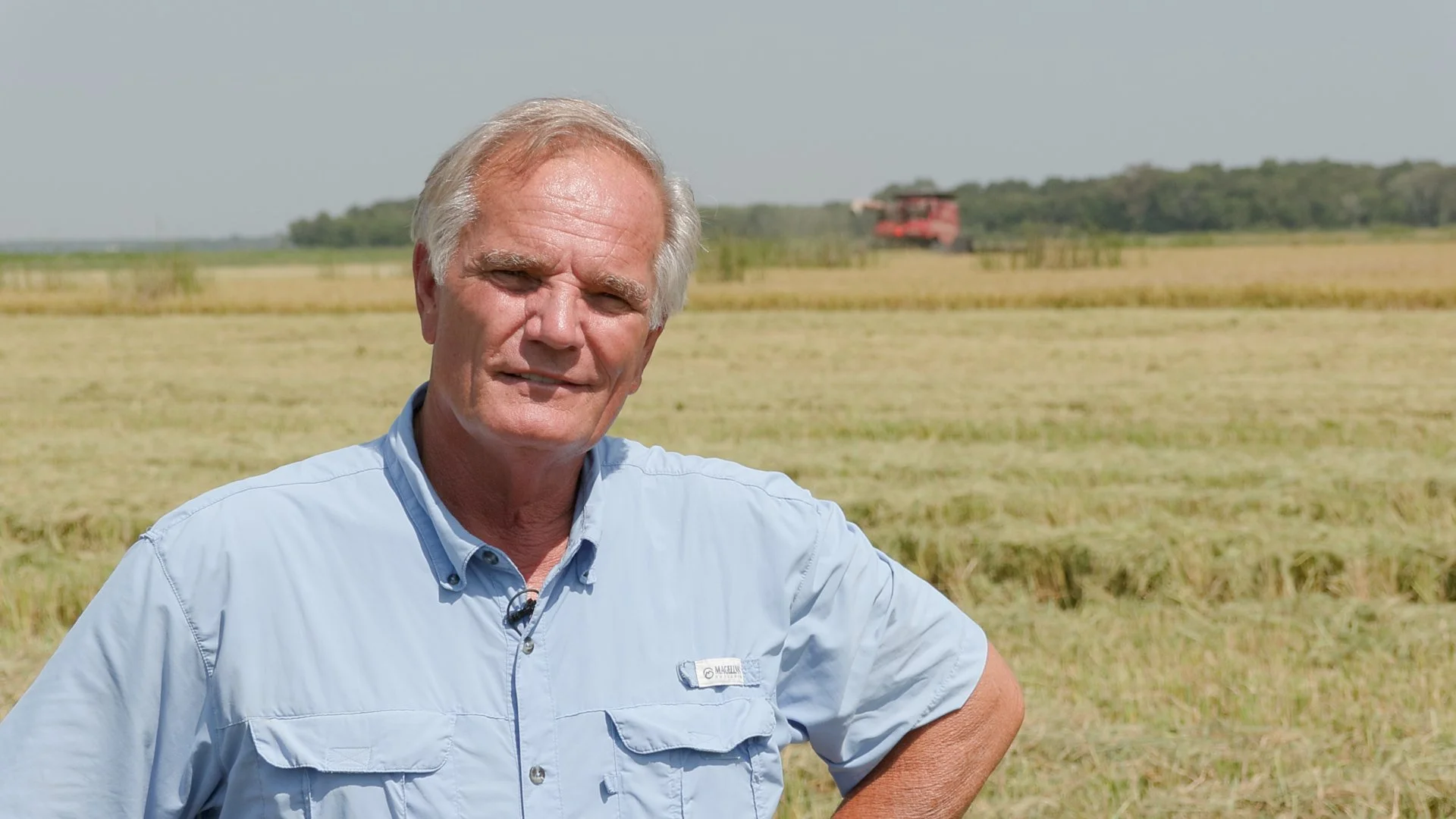
Jeffery Sylvester standing in his rice field in St. Landry parish during harvest.
"Once they taste it, they want it, and then they want more of it," he said. "We got to make sure that we continue giving them that quality of rice."
But Sylvester's biggest concern isn't the research itself — it's who's paying for it. Unlike sugarcane, where checkoff contributions are deducted automatically at the mill, rice farmers must actively write a check. He said only a fraction of growers do, leaving the rice industry to raise a fraction of what it could if participation were universal.
He has a blunt way of putting it.
"There's an old saying — that guy who comes to the supper," Sylvester said. "Everybody knows that guy, and nobody wants to be that guy. He never brings any alcohol, he never cooks, he never cleans up. He always drinks your beer and your whiskey, and he complains about everything. So let's not be that guy. Let's everybody contribute and do what we're supposed to do, and make it a better industry for us and our children and our grandchildren."
For Sylvester, the fix isn't complicated: show up. He credits his own years sitting in rice industry meetings, mostly listening, with reshaping how he sees the whole business.
"It made me look at the whole thing from a totally different perspective," he said. "If I could tell you anything — get involved, no matter what level it is. It's your business, and you need to take hold of it."
Farming, in Sylvester's telling, has never moved in a straight line — good years and bad, prices up and prices down.
"That's life," he said. "You go up, you have your highs, your downs, and you just live with it and you go forward. You don't go backwards."
It's a lesson he's still applying to a mediocre crop coming out of the combine this year, and to the six grandsons who may or may not choose this life for themselves.
"We’re farmers — we know that," he said. "If we don't do it, who's going to do it for us? We can't depend on anybody but ourselves."